


Idaho State Symbols
Idaho’s state symbols reflect the natural heritage and cultural identity that define the Gem State. Idaho’s symbols honor the state’s deep connection to its citizens, land, water, and wildlife. These symbols reinforce how Idahoans have chosen to represent their state’s distinctive character to the nation and the world.
State Amphibian
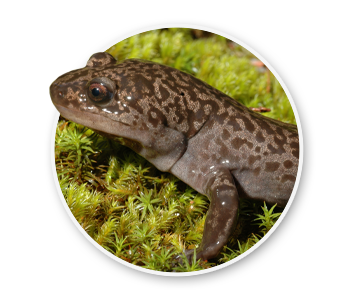
Idaho Giant Salamander
The Idaho Giant Salamander (Dicamptodon aterrimus) is the largest salamander found in the state of Idaho, where it lives almost exclusively. Over their lifetime, these salamanders will metamorphose from a larva to a terrestrial adult, or will mature into an adult but retain the larval form, such as keeping their gills. They have robust bodies and heads and can grow to lengths of 33cm (~13 in). Terrestrial forms of the Idaho Giant Salamander have a marbled pattern of dark spots or blotches on a tan or copper ground color. Idaho Giant Salamanders are generally found in moist coniferous forests. The transformed adults are secretive and seldom found in the open, but can be found in moist areas such as under logs and bark.
Description courtesy of Dr. John Cossel and Ilah Hickman. Photo courtesy of Dr. John Cossel.
State Bird
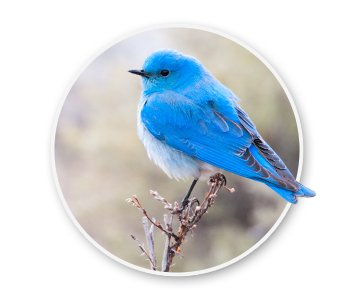
Mountain Bluebird
The Mountain Bluebird (Sialia arctcia) was adopted as the state bird for Idaho by the legislature in 1931. The Bluebird is 6 to 7 inches long and is a member of the Thrush family. Male Bluebirds are a pale sky blue over most of their body, darker on their back. Females are blue-grey with blue wings and tail, duller than the male. Juvenile birds have blue wings with the tail area duller than the adult male, a white eye ring and spotted underparts. Mountain Bluebirds live in open grasslands and nest in holes in trees, crevices and nesting boxes. They have a zig-zagging flight pattern that easily identifies them.

State Dance
Square Dance
The 1989 legislature designated the Square Dance as the American Folk Dance of Idaho. Two of the most commonly cited ancestors to modern square dance are the English Morris dance and the French Quadrille. It is the Quadrille that most point to as the grand-daddy of our modern square dance. One of the earliest records of this type of dance in America is contained in the works of John Playford, a musician and dancing master. His book, ‘The English Dancing Master – Plaine and Easy Rules for the Dancing of Country Dances, with Tunes to Each Dance’ was published in seventeen editions between 1650 and 1728 and contained 918 dances. As the pioneers moved westward, many of the dances were lost or forgotten, but many were preserved, particularly in the southern Appalachians where the running set established itself as one of the deep taproots of western square dance. The running set even had a caller — America’s only unique contribution to the square dance.
Photo courtesy of Arlie Sommer, Idaho Commission on the Arts, and Boise State Public Radio.
State Dinosaur
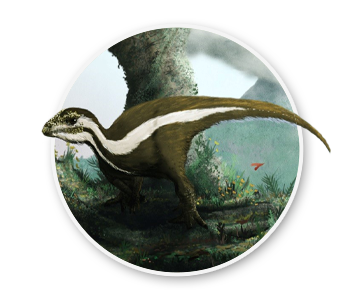
Oryctodromeus
Oryctodromeus cubicularis (affectionately known as Orycto) was designated in 2023 as the official state dinosaur of Idaho thanks to the efforts of Idaho students, educators, and paleontologists. Orycto is the most common dinosaur found in Idaho and is known from 98 million year old rocks in eastern Idaho known as the Wayan Formation. This animal lived in a seasonally dry highland environment west of a continental sea. Fossil discoveries have shown that this animal lived in social groups and raised its young in burrows underground. Measuring about 11 feet long and with an estimated weight of 70 pounds, this small plant-eating dinosaur was a unique member of Idaho ecosystems 98 million years ago.
Photo courtesy of Dr. Mark Witton, United Kingdom.
State Fish
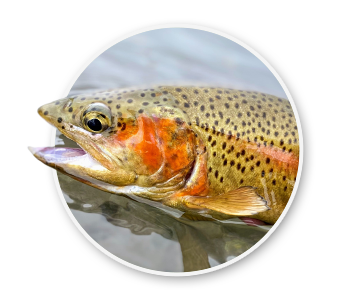
Cutthroat Trout
The Cutthroat Trout was designated the state fish by the 1990 legislature. The Cutthroat, along with the Rainbow and Bull Trout, is native to Idaho. The body color varies with the back ranging from steel gray to olive green. The sides may be yellow brown with red or pink along the belly. The Cutthroat name comes from the distinctive red to orange slash on the underside of its lower jaw. The scientific name for Cutthroat Trout, Oncorhynchus clarki, is in reference to William Clark who first described in detail the Cutthroats of the Columbia River. His partner Meriwether Lewis earlier encountered Cutthroats near the great falls of Montana’s Missouri River in July of 1805. Cutthroat species found in Idaho are the Westslope Cutthroat which is found in northern and central Idaho and the Yellowstone Cutthroat which is found in southeastern Idaho.
State Flag
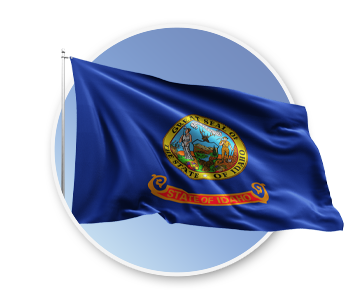
Idaho State Flag
A silk flag, with a blue field, 5 feet 6 inches fly, 4 feet 4 inches on pike is bordered by gilt fringe 2 1/2 inches wide, with the Great Seal of Idaho in the center. The words ‘State of Idaho’ are embroidered in gold block letters two inches high on a red band below the Great Seal. Adopted by the 1907 legislature.

State Flower
Syringa
The Syringa (Philadelphus lewisii) was designated the state flower of Idaho by the legislature in 1931. The species name ‘lewisii’ honors Meriwether Lewis of the Lewis & Clark expedition. Lewis wrote of the plant in his journal. It is a branching shrub growing 3 to 10 feet tall, with clusters of white, fragrant flowers. The blossoms are similar to the mock orange. It grows in open coniferous forests, at forest edge and in moist draws in drier regions providing good coverage for wildlife. Native Americans used its branches for bows, arrows and cradles.
State Fossil
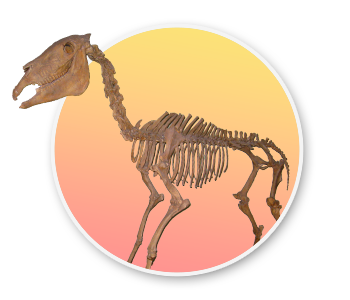
Hagerman Horse
The Hagerman horse fossil, identified initially as Plesippus shoshonensis and later reclassified as Equus simplicidens, is a Pliocene-era ancestor of the modern horse. During its lifetime—which dates to around 3.7 million years ago—it foraged in herds throughout the open grasslands of what is now the western United States and parts of Mexico. At full height, its shoulders ranged to between 43-57 inches tall.
State Fruit
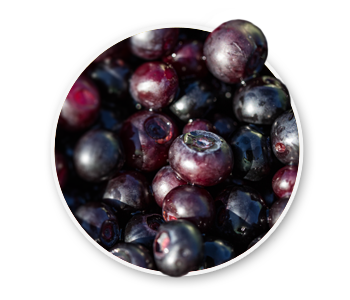
Huckleberry
Several huckleberry species are native to Idaho, all belonging to genus Vaccinium section Myrtillus. The most common and popular is the black or thin-leaved huckleberry (Vaccinium membranaceum). Plants grow slowly, taking up to 15 years to reach full maturity. Black huckleberries produce single plump, dark purple berries in the axils of leaves on new shoots. They depend on an insulating cover of snow for survival during winter and have not been successfully grown commercially. Black huckleberries grow at elevations between 2,000 and 11,000 feet with many productive colonies between 4,000 and 6,000 feet. Black huckleberries usually grow from 1 to 6 feet tall and produce berries up to 1/2 inch in diameter. Huckleberries are a favorite food of bears.
State Gem
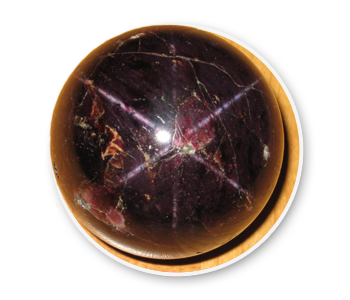
Star Garnet
Gem collections worldwide appreciate and highly value the Idaho Star Garnet. Star garnets are complex silicates, related to quartz, and are found almost exclusively in Idaho and India. Star garnets are a natural stone, not synthetically produced, and are rarer than either star rubies or star sapphires. Normally, the star in the Idaho Garnet has four rays, but it can occasionally have six rays. The color is usually dark purple or plum, and the star seems to glide or float across the dark surface. The star is caused by intrusions of the mineral rutile. The Panhandle National Forest manages a very popular site near St. Maries, Idaho, where the public can try their luck at finding their own coveted star garnet.

State Gem Cut
The Idaho Cut
The Idaho Cut honors Quincy Douglas Howell’s innovative faceting technique. Unlike standardized diamond cuts optimized by industry and machines, Howell’s 1977 “Idaho Cut” design came from years of hands-on testing. He faceted more than 6,500 stones in his lifetime and cataloged each one, adjusting polish, angle, and symmetry to draw the brightest possible light from each gem. He developed his distinctive cut, naming it for the state that was his inspiration, before the advent of digital modeling, relying on meticulous craftsmanship and a deep understanding of how light interacts with structure and color.
Born into poverty in 1908, Howell served in the Army Air Corps during World War II before becoming one of the world’s top five faceting experts, winning the National Championship in 1970. Now available in the public domain, the Idaho Cut allows jewelers and hobbyists alike to access its design, making it a shared resource for future generations. The Howell family, through public outreach and a dedicated website, continues to educate others about the cut’s origins, significance, and beauty.
Photo courtesy of the Howell family.
State Horse
Appaloosa
The history of the Appaloosa (Equus ferus caballus) is as vivid and enduring as its spotted coat. The Spanish first introduced horses to North America in the 1500s, and they soon transformed indigenous cultures across the West. Yet, the breed’s true legacy is defined by the horsemanship of the Nez Perce, or Nimiipuu. The Nez Perce revered and selectively bred Appaloosas for their intelligence, endurance, and swift agility, thereby cementing the breed as a key part of their tribal identity, especially during their 1,300-mile flight under Chief Joseph in the 1877 Nez Perce War.
Over time, settlers began referring to the region’s spotted horses as “Palouse” horses, a reference to the nearby river, which eventually evolved into the name “Appaloosa.” Though the Nez Perce War of 1877 devastated tribal herds, public fascination with the breed endured. In 1938, a group of resolute horsemen in Moscow, Idaho, founded the Appaloosa Horse Club to preserve and promote the breed. The coloring of the Appaloosa coat is distinct in every individual horse and ranges from white blanketed hips to a full leopard. At the time of the official designation as the state horse, the bill’s sponsors estimated that there were 10,000 Appaloosas in Idaho.


State Insect
Monarch Butterfly
The Monarch Butterfly (Danaus plexippus) is a remarkable migrator, traveling many miles during its lifetime, which typically ranges from a few weeks to twelve months. Early settlers to North America from Europe, particularly those from Holland and England, named the butterfly “Monarch,” after the King of England. The monarchs’ color suggested the name. Monarchs range in mass from .25 to .75 grams (a dime has a mass of 2.3 grams). Males are usually larger than females. Female Monarchs lay eggs on the underside of milkweed plants. The larvae then feed on the plants. Monarchs go through a complete metamorphosis in 3 to 6 weeks.
State Raptor
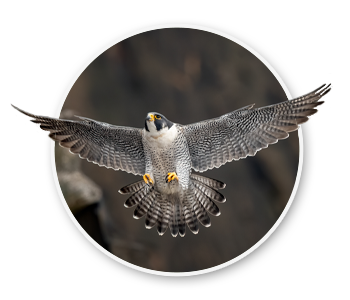
Peregrine Falcon
The Peregrine Falcon (Falco peregrinus) ranks among the fastest animals on Earth. In its signature hunting dive, or “stoop,” it rockets toward its prey at speeds that can reach 200 miles per hour (322 km/h), striking with such precision that it disables birds in flight while protecting itself from injury. The name “peregrine” means “wanderer,” a fitting descriptor for a bird that can migrate up to 15,500 miles each year, journeying from Arctic tundra to South American wintering grounds. The Peregrine Falcon has a body length of 15-20 inches, a 3 1/2-foot wingspan, and weighs 1.25 to 2.75 pounds. Peregrine falcons reach maturity by their second or third year, with females larger and more strongly marked than males. Pairs typically mate for life, performing complex flight displays and mid-air prey passes during courtship. They live mostly along river valleys, cliffs, coastlines, and—more recently—urban towers and bridges. Their diet primarily consists of medium-sized birds, although they also hunt bats, rodents, and other small mammals. The Peregrine Falcon has one of the most global distributions of any bird of prey.

State Tree
Western White Pine
Northern Idaho is home to the largest remaining stand of western white pine (Pinus Monticola Pinaceae) in the United States. The western white pine has many fine qualities, such as straight grain and a soft, even texture. These specimens can climb to heights of 175 feet with a trunk diameter from 5 to 8 feet. As of 2023, the world’s tallest Western White Pine, rising to 219 feet, stands near the Elk River, in northern Idaho.
State Vegetable
Potato
Idaho’s unique environment provides nearly perfect growing conditions for the potato. The soil, water, clean air and climate in Idaho contribute to those consistently high-quality potatoes that have made Idaho famous for so many years. Idaho’s rich volcanic soil is ideally suited for potatoes. Warm, sunny days, cool nights and water from melting snow in nearby mountains make the perfect combination for growing the world’s best potatoes.

Photo: The Idaho State Flag